Flutter Overlays
Introduction to Overlays
Overlays are graphical elements rendered into the video output that provide visual information during sound post-production sessions. Cue Pro offers several overlay types, each serving a different purpose:
- Timecode - displays the current timeline position
- Markers - annotate and identify sections of a project
- Streamers - provide visual countdowns to sync points
- Flutters - mark Hit Points and tempo with flashing visual cues
- ADR Cues - dialogue cueing and recording workflows
In addition to overlays, Cue Pro provides the SCENES track and SHOT CHANGES track for timeline-based navigation and edit structure reference - see the Scenes Track and Shot Change Track chapters.
This chapter covers all aspects of Flutters - how to create, configure, edit, and trigger them via MIDI.
Many experienced composer-conductors prefer to avoid an actual metronome or click track when recording film music. Whilst clicks can guarantee a synchronous performance to picture, they often produce an aesthetically mechanical result. Flutters provide a visual alternative - the conductor can see the tempo cue without imposing an audible click on the performers.
Flutter Overlays
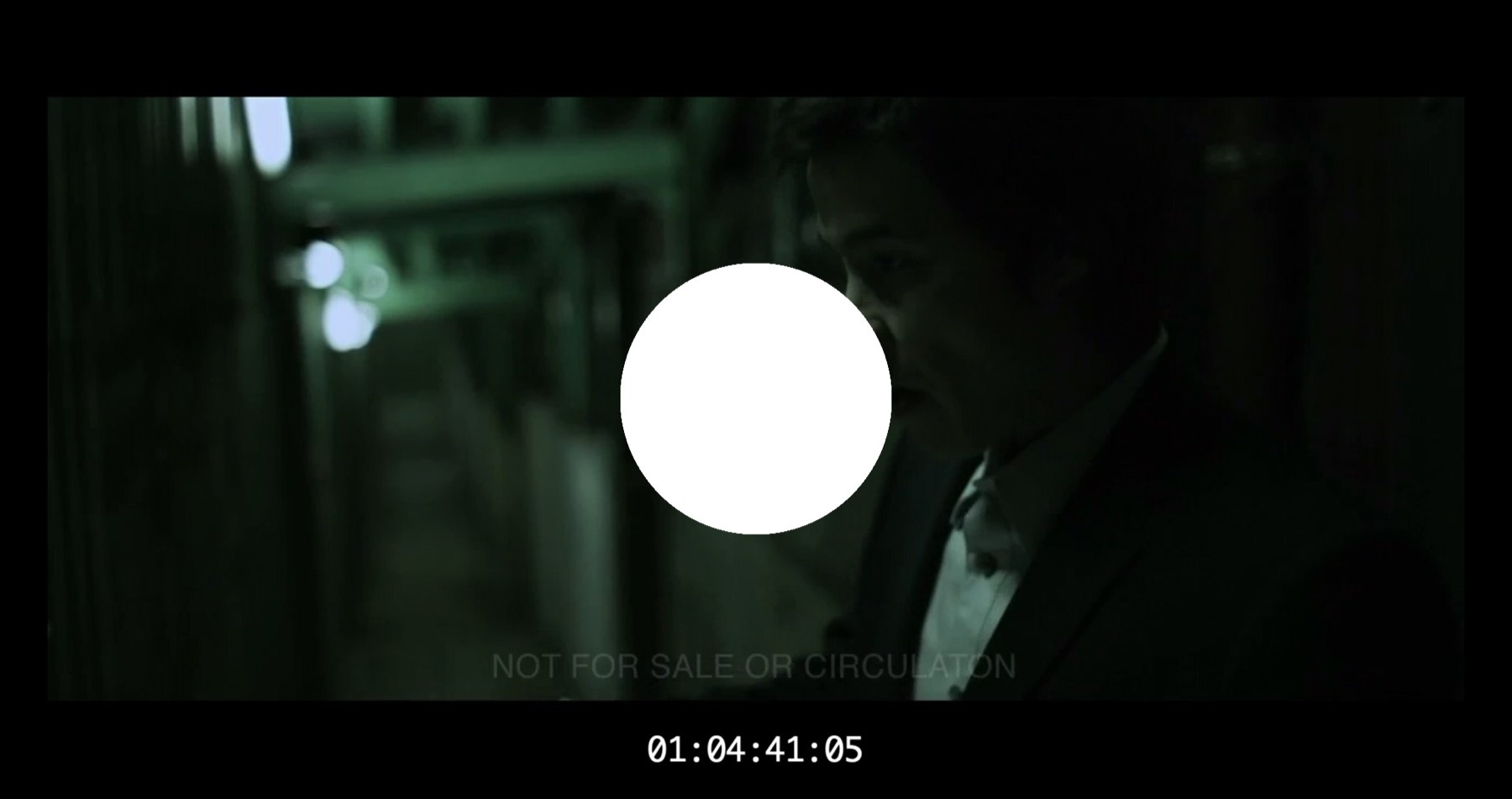
A Flutter is a series of rapid circular flashes - known as Punches - that mark a Hit Point on the timeline. Each individual flash is a Punch; a Flutter is a cluster of Punches played in quick succession. A Flutter can consist of 1, 3, 5, or 7 Punches. When set to 1, the Flutter is a single Punch - one circular flash. When set to 3, 5, or 7, the Flutter creates a rapid flicker effect that works like a visual metronome, helping a conductor confirm the Hit Point and tempo of specific downbeats or tempo changes - without the distraction of audible beeps or a click track. A single Punch can also appear automatically at the end of a Streamer or ADR Cue event, controlled by the Punch After Streamer setting - this is separate from standalone Flutter events.
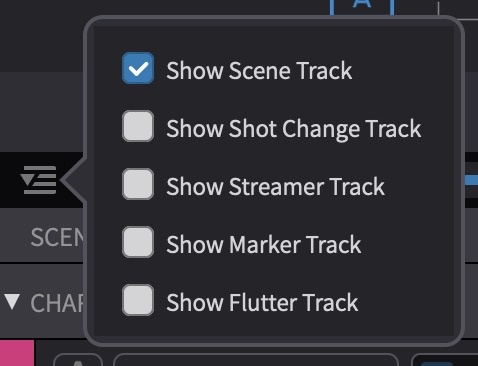
Flutters appear as Visual Events on a dedicated FLUTTERS track in the Visual Events section.

The Flutter track can be shown or hidden using the show/hide pull-down tab located at the top left of the Visual Events section.
During playback, the Flutter fires on the video output at the Hit Point position.
Note: Overlays are enabled by default. If Flutter overlays are not visible during playback, see Enabling Flutter Overlays later in this chapter.
Viewing and Editing Flutter Properties
Flutter properties can be viewed and edited in three places:
- The Properties tab (Media Mode) shows the selected Flutter's Hit Point and Duration. Double-click a Flutter to open it, or click the PROPERTIES tab at the top left of the Visual Events section.
- The Edit Event window (Pro Tools Integrated Mode) opens a separate window for editing the Hit Point and Duration. Double-click a Flutter to open it. Colour is not available in the Edit Event window - use the Properties tab or Event List to change a Flutter's colour.
- The Event List shows all events in a table format, allowing multiple Flutters to be viewed and edited at once. Press Shift & L, or select Event List from the Window menu, to show or hide it.
All three are used throughout this chapter for creating, editing, and managing Flutters.
Flutter Properties
The per-event properties are Hit Point and Duration (number of Punches). Colour is set globally for all Flutters in Preferences / Settings → OVERLAYS → Flutter tab and cannot be overridden per-event.
- Hit Point - the timecode where the Flutter fires (the sync point)
- Duration - how many Punches the Flutter contains (1, 3, 5, or 7)
- Cue # - an optional identifier for the Flutter, visible and editable in the Event List only (not shown in the Properties tab or Edit Event window). Cue numbers are not auto-assigned - they are entered manually.
Switching Between Timecode and Feet+Frames
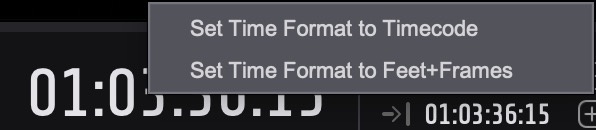
To switch between Timecode and Feet+Frames display, right-click the main counter when it is not highlighted. Select either Set Time Format to Timecode or Set Time Format to Feet+Frames. This changes the display format of the Timelines, counters, and the Timecode overlay simultaneously.
Edit Mode: Timeline Range vs Target Event
Cue Pro offers two edit modes, as they determine how Flutters behave when selected and modified in the timeline. The Edit Mode can be switched using the Edit Mode toggle in the Controller Bar, or by pressing G.
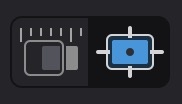
In Timeline Range Mode, the current timeline selection determines which Flutters are affected by edit operations. The selection remains active until a new selection is made or the timeline is clicked elsewhere to deselect.
Target Event Mode keeps selected Flutters targeted even when scrubbing or nudging the playhead, which is useful for maintaining a selection while navigating the timeline. Discontiguous Flutters can be selected directly from the Event List.
Edit Mode switches automatically when selecting discontiguous events from the Event List - Cue Pro enters Target Event Mode to accommodate non-contiguous selections.
Note: In Target Event Mode, clicking the timeline selects existing events rather than making a timeline range selection.
The Edit Mode setting is stored with the project and restored when the project is reopened.
Creating Flutters
To create a Flutter, press the F hotkey. A new Flutter event will be created at the current playhead position using the defaults specified in Preferences / Settings → OVERLAYS → Flutter tab.
The same result can also be achieved by selecting New Flutter Event from the Event menu.
Flutters can also be created from the Event List using the Add New Event button (+). This button adds a new event based on the most recently or most frequently used visual event type.
Note: When adding several Flutters in succession, the button will recognise this and continue adding Flutters when pressed.
Editing Flutters
Editing the Hit Point
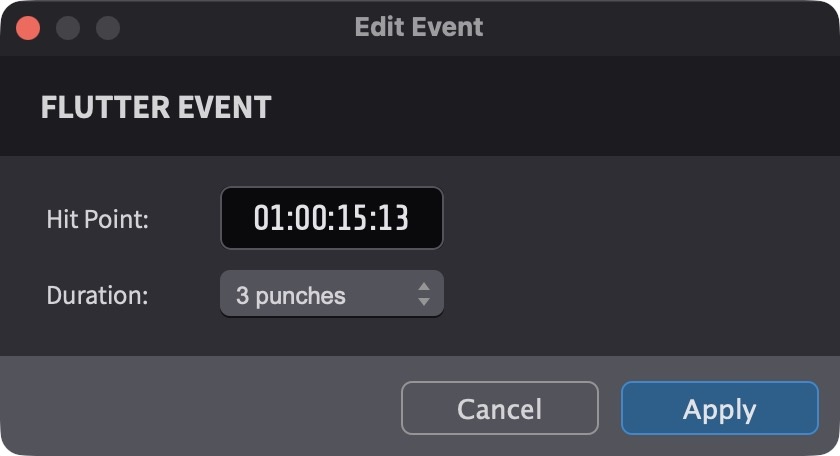
The Hit Point timecode can be edited numerically in the Properties tab (Media Mode) or the Edit Event window (Pro Tools Integrated Mode). Double-clicking a Flutter in the FLUTTERS track or the Event List opens the relevant view, where the Flutter's properties can be edited.
Pro Tools Integrated Mode - Edit Event Window:
Media Mode - Properties Tab:
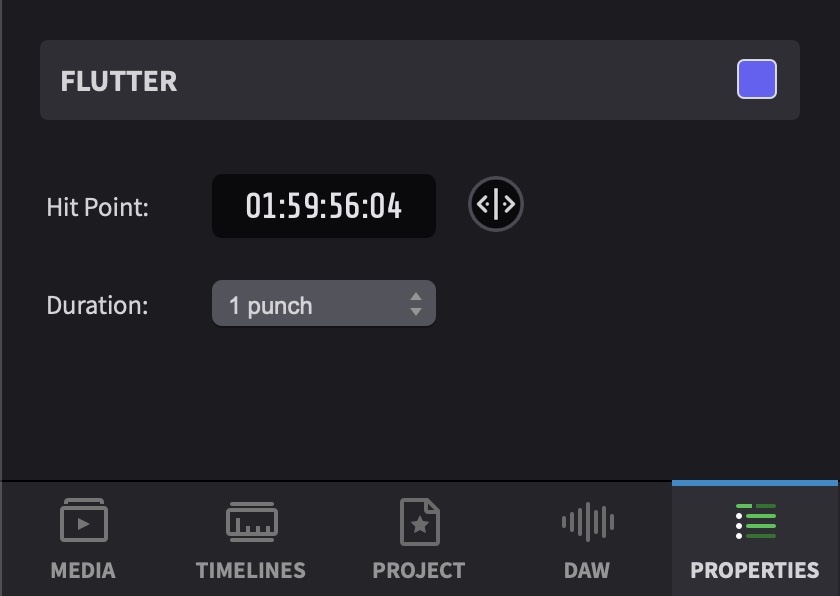
The Hit Point timecode field can be edited in multiple ways. To scrub-adjust the timecode, click and hold the arrow button to the right of the timecode field and drag left or right. Dragging slowly produces finer changes, while dragging further produces larger changes.
To retype the timecode, click the field once so the entire timecode is selected, then type the full hours, minutes, seconds, and frames (excluding colons). The period and comma keys can be used as shortcuts to enter double zeroes into timecode fields, speeding up entry.
Press Enter or click elsewhere to confirm the new value.
To adjust only one specific timecode field (such as frames), double-click just that field so only it is selected, then retype the value.
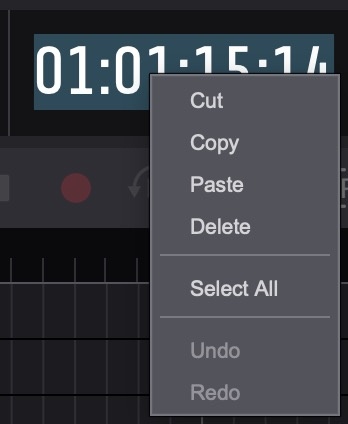
To copy and paste timecode values, double-click the timecode field to highlight it, then right-click to access a context menu with Cut, Copy, Paste, Delete, Select All, Undo, and Redo. This context menu is available on all timecode fields throughout the application - including the main counter, selection in/out counters, and timecode fields in the Properties tab, Edit Event window, and Event List. It allows timecodes to be copied from external sources - such as a DAW, spreadsheet, or email - and pasted directly into the field, or copied from Cue Pro and pasted elsewhere.
Moving Flutters
One or more Flutters can be moved on the timeline by selecting them and dragging to the new position.
Selected Flutters can be nudged frame-by-frame using the , (comma) key to move 1 frame earlier, or the . (period) key to move 1 frame later.
Duplicating Flutters
To duplicate one or more highlighted Flutters while moving them to a new position, hold Option while dragging the Flutters on the timeline.
Alternatively, with Flutters highlighted, press Command & D to duplicate them in place - the new Flutters are created at the exact same position as the originals, stacked on top. This command is also available from the Event menu as Duplicate Current Events.
Deleting Flutters
One or more selected Flutters can be deleted by pressing the Delete key. This command is also available from the Event menu as Remove Selected Events.
Muting Flutters
One or more selected Flutters can be muted by pressing Command & M. Pressing the same shortcut again unmutes them. Muting a Flutter hides it from the overlay output without deleting it from the project. Muted Flutters appear greyed out on the timeline and in the Event List, and are skipped during prev/next event navigation. The mute state can also be toggled directly via the On column in the Event List.
Sorting Events
The Event List can be sorted by clicking a field heading to sort by that column. Clicking again switches between ascending and descending order.
Sorting is useful for organising events in different ways - for example, sorting by colour to group similarly styled Flutters together, or sorting by Hit Point to find the last event in the timeline.
Customising the Event List
Column order can be rearranged by clicking a column header and dragging it to a new position.
Column width can be adjusted by clicking the right edge of a column header and dragging.
Columns can be shown or hidden by right-clicking (or Control-clicking) any column header.
Navigating Events
The Event List provides several methods for navigating between events:
- ↑ or Command & ← to select the previous event
- ↓ or Command & → to select the next event
These commands navigate through all visual events in the Event List, not just Flutters. Navigation follows the current sort order. If navigation behaves unexpectedly, check which column the list is sorted by and whether it is set to ascending or descending order.
When Cue Pro is not in focus, system-wide hotkeys can be used to navigate between events where they have been configured in Preferences / Settings. Command & F5 selects the previous event and Command & F6 selects the next event.
On Macs where F keys are not configured to act as standard function keys, Fn must also be held - for example, Command & Fn & F5. This setting can be found in System Settings → Keyboard → Function Keys.
The Go To command (Command & G) allows quick navigation directly to a specific event. Pressing the shortcut opens a text input box. Begin typing and a list of matching candidates from all event types appears immediately below. Clicking an event from the list selects it and moves the playhead to its position.
Typing # followed by a cue number searches specifically by cue number — for example, entering #12 will find all cues containing 12 in their cue number.
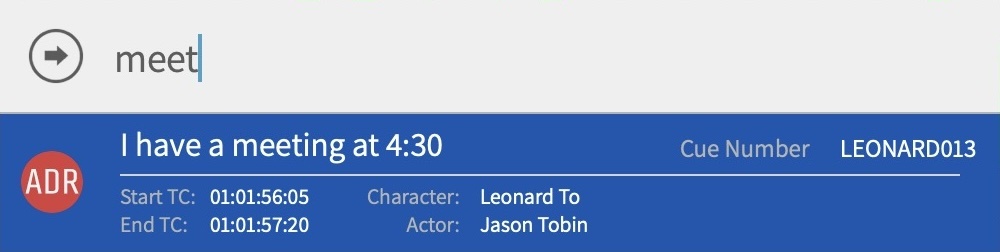
Selection expansion commands allow multiple events to be selected quickly. These commands apply to all visual event types, not just Flutters:
- Command & Option & A includes all events before the current selection
- Command & Shift & A includes all events after the current selection
- Command & A selects all events in the list
Navigating Flutters on the Timeline
In Timeline Range Mode, Flutters can be navigated directly on the timeline using the Tab key. Press Tab to move the playhead forward to the next event boundary, and Option & Tab to move backward. The playhead stops at the start and end of each Flutter, making it straightforward to navigate through Flutters on the timeline.
Hold Shift while pressing Tab to make a timeline selection as the playhead advances, extending the selection from the current position to the next event boundary. Shift & Option & Tab extends the selection in the opposite direction.
Event Selection Playhead Behaviour
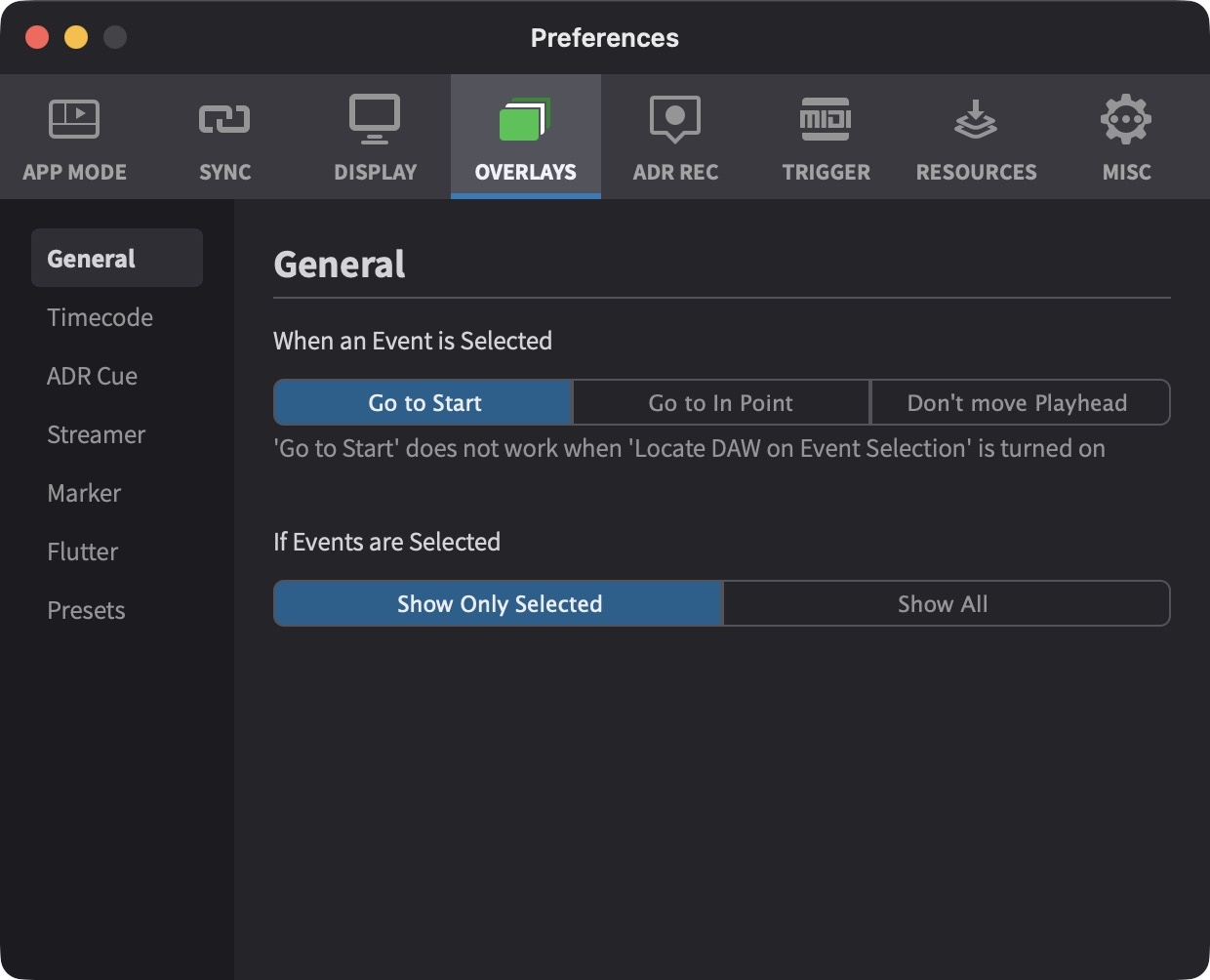
Settings under Preferences / Settings → OVERLAYS → General tab control what happens when an event is selected:
When an event is selected - choose between Go to Start, Go to In Point, or Don't move Playhead. This setting controls playhead positioning when an event is selected. The distinction between Go to Start and Go to In Point primarily affects overlay types with Streamer countdowns - ADR Cues and Streamers - where the start of the pre-roll differs from the Hit Point.
If Events are Selected - choose between Show Only Selected (only the selected event's overlays are rendered) or Show All (all events' overlays are rendered during playback).
Playback Modes
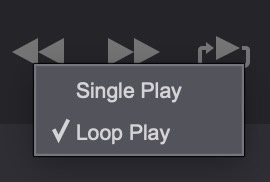
Hold down the Control key while clicking the play button to choose between Single Play and Loop Play modes.
MIDI Triggers
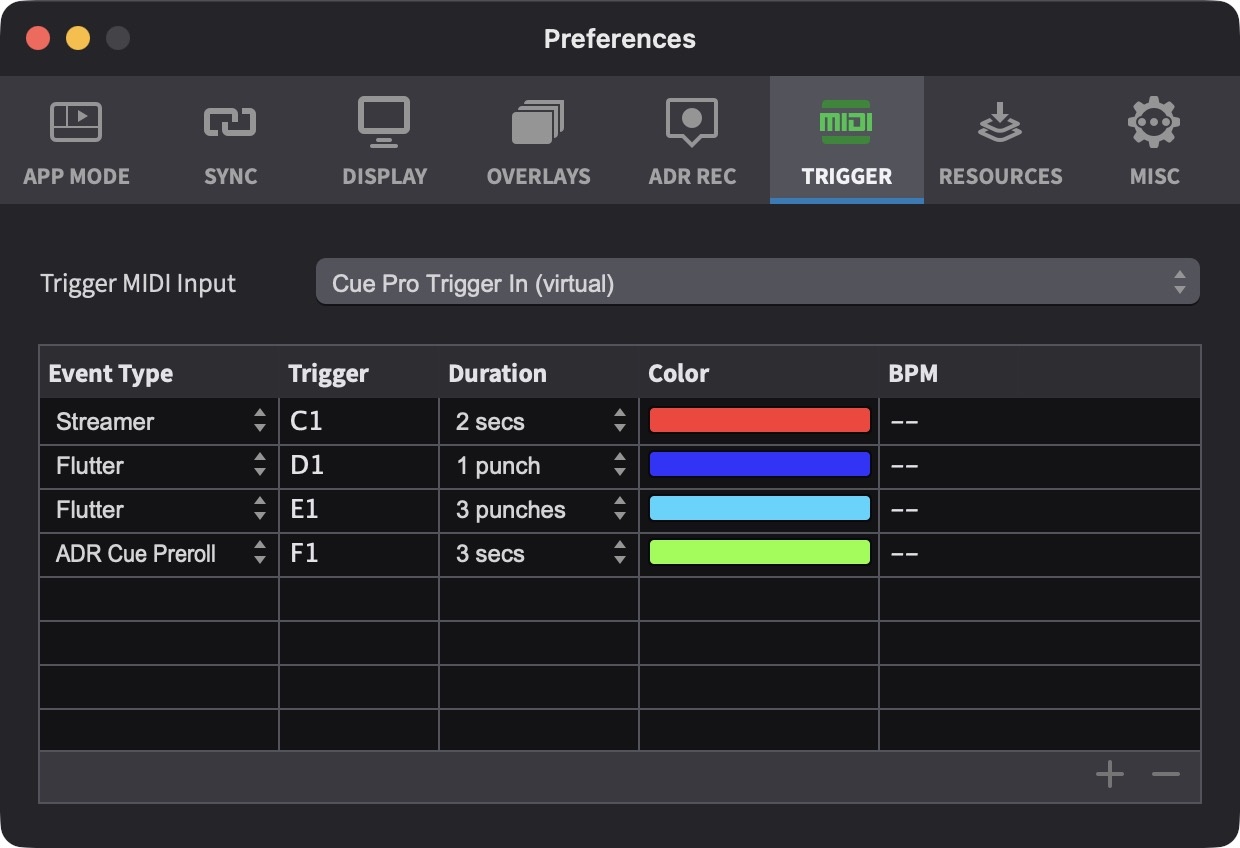
Flutters can be triggered via external MIDI events from the DAW. This allows Flutters to fire in real time during playback by sending MIDI notes from Pro Tools to Cue Pro. Multiple trigger configurations can be defined, each mapped to a different MIDI note - for example, C1 could trigger a single Punch to mark a sync hit, while D1 triggers a 3-Punch Flutter to confirm the downbeat of a new section.
Note: MIDI triggers are only available in Media Mode. They are not available in Pro Tools Integrated Mode.
In Cue Pro
Open the TRIGGER tab in Preferences / Settings. Verify that the Trigger MIDI Input is set to Cue Pro Trigger In (virtual).
Press the + button to add a new trigger row. Each row defines the following:
- Event Type - set to Flutter
- Trigger - the MIDI note that will trigger this Flutter (e.g. C1, D1, E1)
- Duration - the number of Punches in the Flutter
- Color - the colour of the Flutter
Note: When entering the MIDI note value in the Trigger field, a capital letter must be used (e.g. C1, not c1). The value will not change if a lowercase letter is entered.
Multiple rows can be added, each with a different MIDI note, duration, and colour.
In Pro Tools
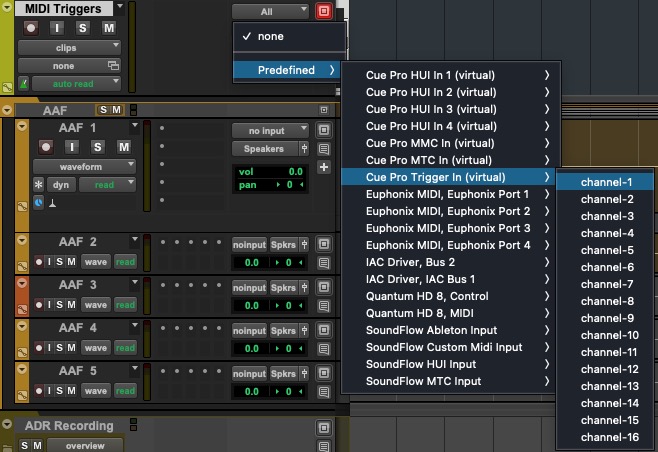
To send MIDI triggers from Pro Tools to Cue Pro, create a new MIDI track in the Pro Tools session. Set the track's output to Cue Pro Trigger In (virtual) → Channel-1.
As with MTC and MMC virtual ports, it is advised to always launch Cue Pro before launching Pro Tools so that the virtual ports are available.
Place MIDI notes on this track at the timecode positions where Flutters should fire. The note values must match the notes defined in the Cue Pro TRIGGER tab. During playback, Pro Tools sends the MIDI notes to Cue Pro, which triggers the corresponding Flutter at each note position.
Note: MIDI triggers may not be frame-accurate when using supported video devices from Avid, Blackmagic Design, or AJA.
Enabling Flutter Overlays
Cue Pro operates in one of two modes - Pro Tools Integrated Mode and Media Mode - which determines how video devices and their overlay controls are presented in the Device List. The current mode affects how overlays are enabled and which devices are available.
Pro Tools Integrated Mode
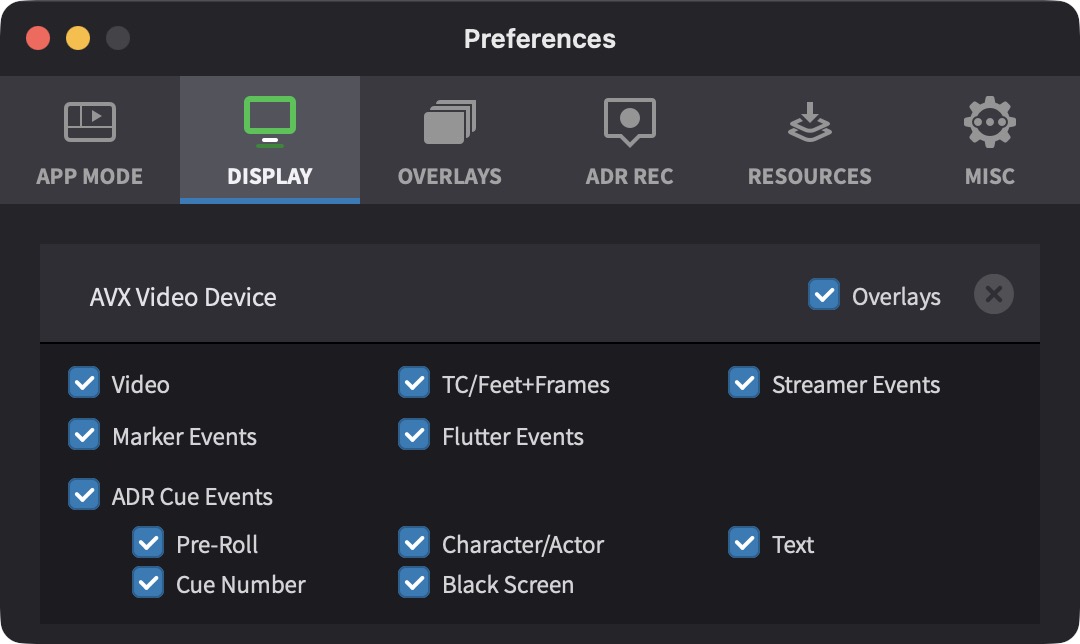
In Pro Tools Integrated Mode, a single Pro Tools AVX Video Device is shown in the Device List in Preferences / Settings → DISPLAY tab. The Overlays checkbox toggles all overlays on or off for this device. When Overlays is enabled, the Flutter Events checkbox controls whether Flutters are visible.
Media Mode
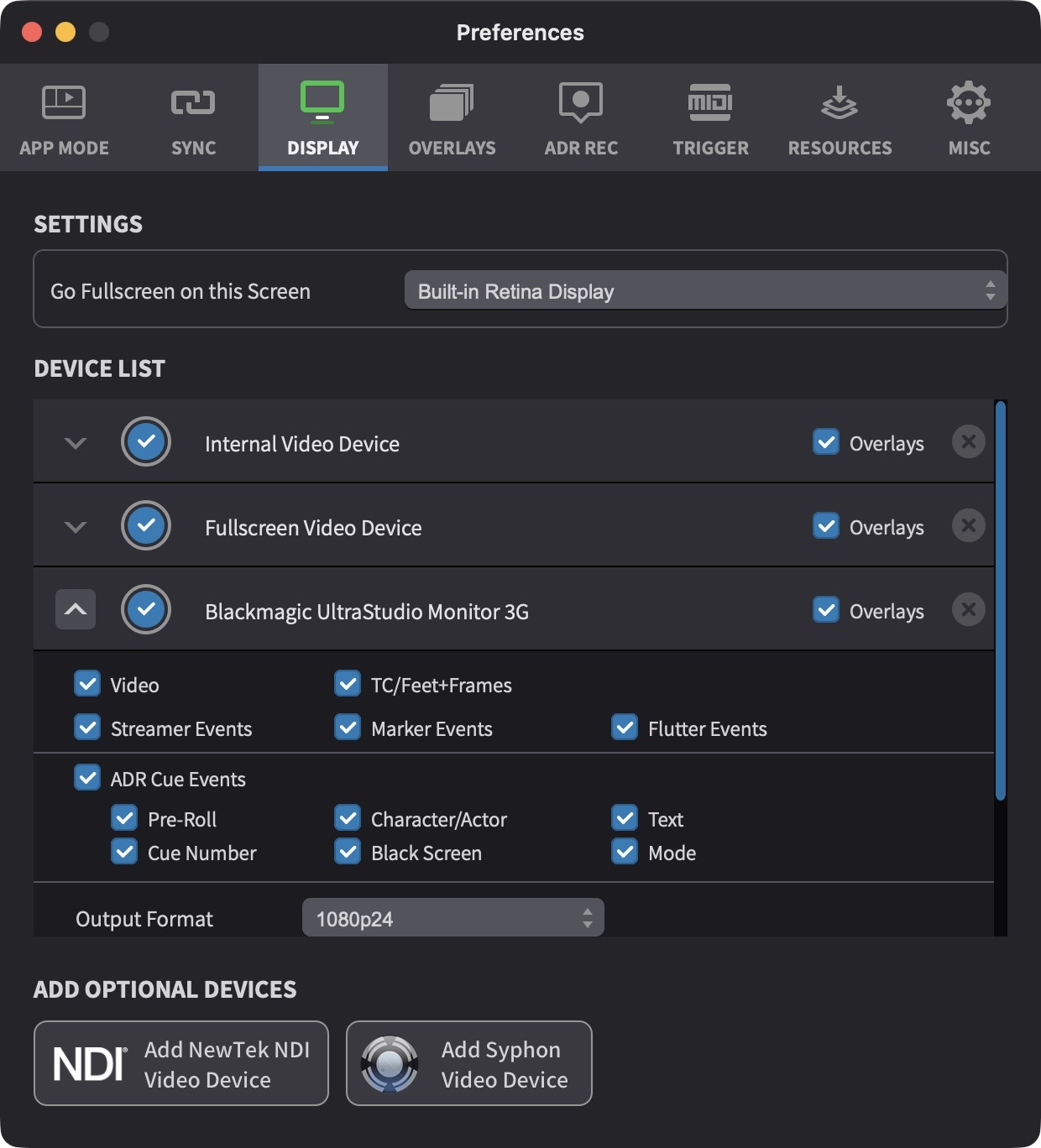
In Media Mode, the Device List shows all available video output devices - including video hardware, the Fullscreen Video Device, and the Internal Video Device - each with independent overlay controls. Click on the left-most grey arrow of the relevant video device to show the expanded settings, so that the arrow is pointing up.
Each device can independently show or hide Flutter overlays using the Flutter Events checkbox. The Overlays checkbox on each device toggles all overlay types on or off for that device. This allows flexibility when setting up multiple outputs - for example, Flutters can be visible on a conductor's monitor while an editor's display remains clean.
Global Toggle Shortcuts
To toggle all overlays across all devices globally, press Shift & Command & B, or select Toggle Overlays Globally from the View menu.
Flutter Settings
Flutter overlay settings are configured in the Flutter tab in Preferences / Settings → OVERLAYS.
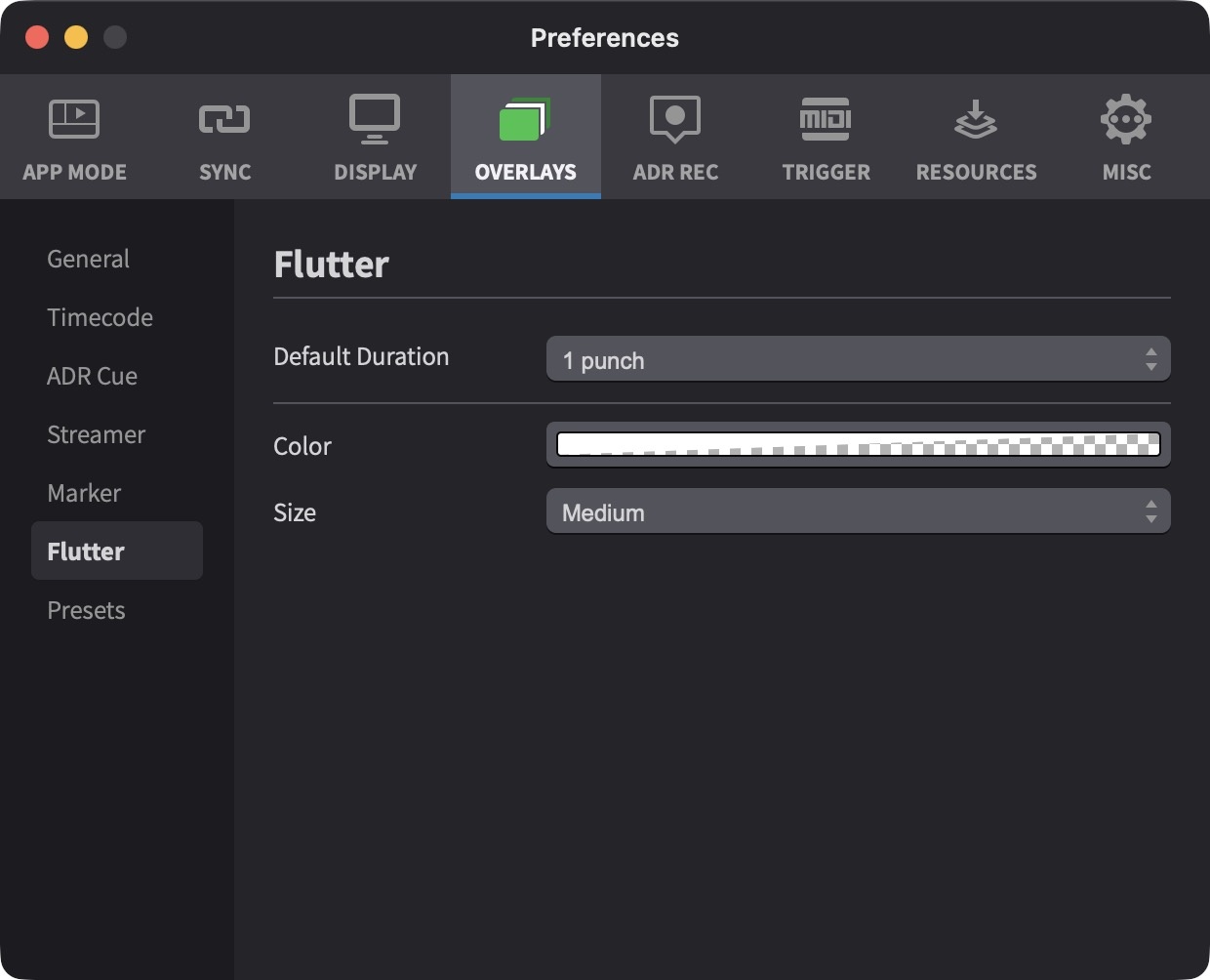
When a setting is adjusted, a temporary preview of the overlay is automatically displayed on all available video devices for a few seconds, allowing settings to be fine-tuned visually. Overlays do not need to be enabled in the Device List, and events do not need to be added to the timeline, in order to preview settings changes.
If overlays are visible when adjusting settings but not during playback, ensure that the overlay type is enabled for the relevant device in the Device List (Preferences / Settings → DISPLAY tab), and that overlays have not been disabled globally via Toggle Overlays Globally in the View menu.
Overlay appearance settings apply globally - they are shared across all video devices, projects, and timelines.
Default Duration sets how many Punches are used when creating a new Flutter event. Select 1 punch for a single Punch, or 3, 5, or 7 punches for a multi-Punch Flutter.
Color sets the colour of the Punch globally - all Flutter events share this colour. A colour is chosen from the Base Colors palette and adjusted using the Lightness slider. The colour picker also includes an Opacity slider, which can be used to make the Punch semi-transparent.
Size sets the size of the Punch circle on screen. Select between Small, Medium, or Large.
Punches in Streamers and ADR Cues
In addition to standalone Flutter events, a single Punch can appear automatically at the end of Streamer and ADR Cue events. This is controlled by the Punch After Streamer toggle in the Streamers tab in Preferences / Settings → OVERLAYS. When enabled, a flashing circle appears at the Hit Point as the Streamer finishes. This applies to both standalone Streamer events and Streamers displayed as part of ADR Cue events. This setting does not affect standalone Flutter events on the FLUTTERS track.
The visual appearance of the Punch - Color and Size - is configured in the Flutter tab, using the same settings as standalone Flutter events. This includes Punches displayed at the end of Streamer and ADR Cue events.
Overlay Presets
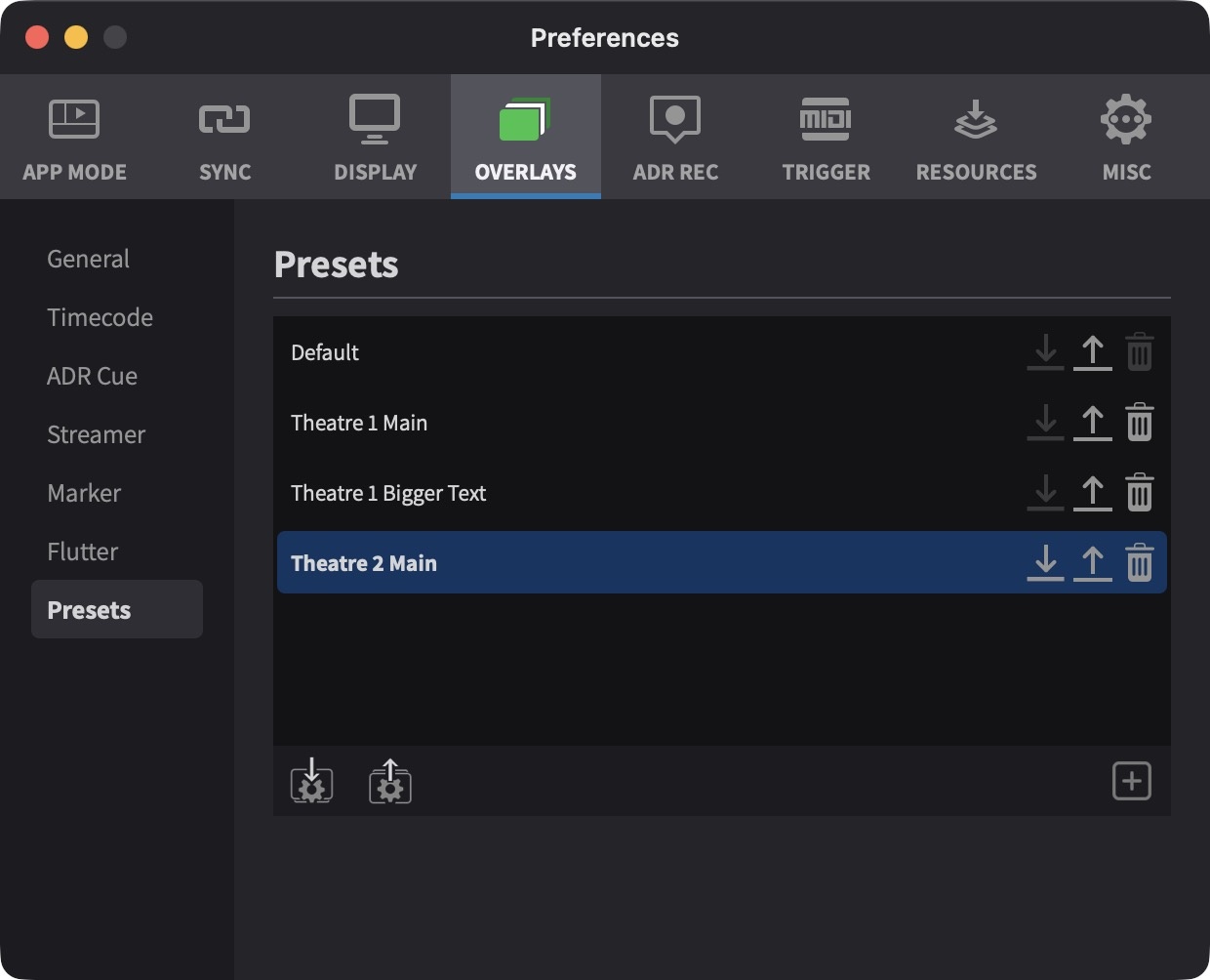
Overlay settings can be saved and managed through the Presets item in the OVERLAYS sidebar in Preferences / Settings. A Default preset is always present and cannot be deleted or renamed. The currently active preset is highlighted, and a modified indicator shows when unsaved changes exist.
Loading a preset: Double-click the preset name to load it.
Saving changes to a preset: Click the Save button (↓) on the preset row. The Default preset cannot be overwritten. When the current settings have been modified since the preset was last loaded or saved, an asterisk (*) appears after the preset name to indicate unsaved changes.
Reverting a preset: Click the Revert button (↑) on the preset row to discard unsaved changes and restore the preset's last saved state.
Creating a new preset: Click the + button below the preset list.
Renaming a preset: Click the preset name in the list. The Default preset cannot be renamed.
Deleting a preset: Click the Delete button on the preset row. The Default preset cannot be deleted.
Importing and exporting presets: Use the
Import (↓) and Export (↑)
buttons at the bottom left of the Presets page to share
.dispPref preset files between studios, editors, or
machines.