Marker Overlays
Introduction to Overlays
Overlays are graphical elements rendered into the video output that provide visual information during sound post-production sessions. Cue Pro offers several overlay types, each serving a different purpose:
- Timecode - displays the current timeline position
- Markers - annotate and identify sections of a project
- Streamers - provide visual countdowns to sync points
- Flutters - mark Hit Points and tempo with flashing visual cues
- ADR Cues - dialogue cueing and recording workflows
In addition to overlays, Cue Pro provides the SCENES track and SHOT CHANGES track for timeline-based navigation and edit structure reference - see the Scenes Track and Shot Change Track chapters.
This chapter covers all aspects of Markers - how to create, configure, edit, and navigate them.
Markers serve as flexible annotation tools for composers, music editors, and other post-production professionals to mark and organize project elements. Common use cases include marking the start and end of musical cues, identifying where existing music belongs or should be replaced, noting spotting observations and editorial requirements, and allowing supervisors and collaborators to leave annotations at critical junctures.
Marker Overlays
Markers are simple text-based annotation overlays that identify and annotate specific sections of a project. Each Marker consists of an In Point, an Out Point, and a Text field.
Markers appear as yellow Visual Events on a dedicated MARKERS track in the Visual Events section, making them visually distinct and easy to identify.

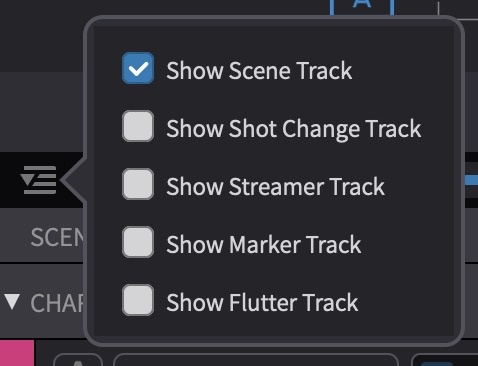
The Marker track can be shown or hidden using the show/hide pull-down tab located at the top left of the Visual Events section.
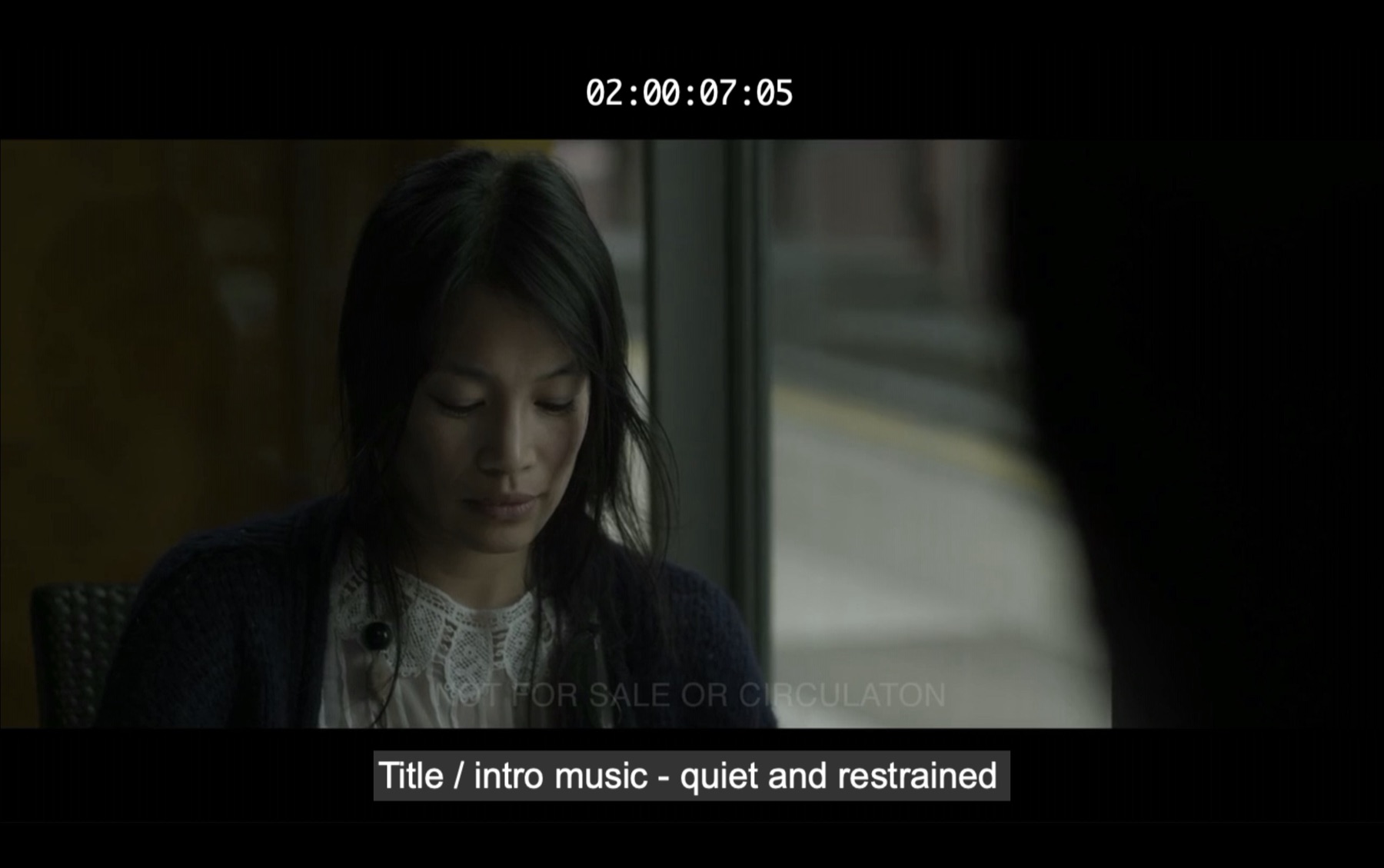
During playback, the Marker text is displayed on the video output for the duration of the event.
Note: Overlays are enabled by default. If Marker overlays are not visible during playback, see Enabling Marker Overlays later in this chapter.
Viewing and Editing Marker Properties
Marker properties can be viewed and edited in two places:
- The Properties tab (Media Mode) or Edit Event window (Pro Tools Integrated Mode) shows the selected Marker's details - its In Point, Out Point, and Text. Double-click a Marker to open it, or click the PROPERTIES tab at the top left of the Visual Events section.
- The Event List shows all events in a table format, allowing multiple Markers to be viewed and edited at once. Press Shift & L, or select Event List from the Window menu, to show or hide it.
All three are used throughout this chapter for creating, editing, and managing Markers.
Marker Properties
Each Marker has the following properties:
- In Point - the timecode where the Marker begins (the first frame of the event)
- Out Point - the timecode marking the end of the Marker (exclusive - the first frame after the event)
- Text - the annotation text displayed on the video output during the Marker's duration
- Cue # - an optional identifier for the Marker, visible and editable in the Event List only (not shown in the Properties tab or Edit Event window). Cue numbers are not auto-assigned - they are entered manually.
Switching Between Timecode and Feet+Frames
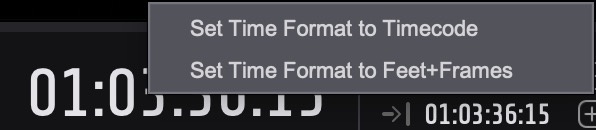
To switch between Timecode and Feet+Frames display, right-click the main counter when it is not highlighted. Select either Set Time Format to Timecode or Set Time Format to Feet+Frames. This changes the display format of the Timelines, counters, and the Timecode overlay simultaneously.
Edit Mode: Timeline Range vs Target Event
Understanding the two edit modes available in Cue Pro is essential, as they determine how Markers behave when selected and modified in the timeline. The Edit Mode can be switched using the Edit Mode toggle in the Controller Bar, or by pressing G.
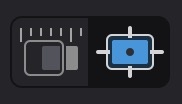
Timeline Range Mode uses the timeline selection to determine which Markers are affected by edit operations. Markers wholly within the selection are always fully affected. Markers that are only partially within the selection behave differently depending on the operation - for example, a partial selection will trim a Marker when deleting, but will simply ignore it when moving. The specific behaviour for each operation is noted throughout this chapter. In Timeline Range Mode, the current selection remains active until a new selection is made or the timeline is clicked elsewhere to deselect.
Target Event Mode maintains a selected Marker as the target even when scrubbing or nudging the playhead. In this mode, all highlighted Markers are treated as wholly selected regardless of the timeline selection position - even partial selections will include the full Marker - which means operations such as delete and move always apply to the complete Marker. Discontiguous Markers can be selected directly from the Event List. Target Event Mode is especially useful for fine-tuning Marker timings during playback, as the target Marker remains active while the playhead moves across the timeline.
Edit Mode switches automatically when selecting discontiguous events from the Event List - Cue Pro enters Target Event Mode to accommodate non-contiguous selections.
Note: In Target Event Mode, clicking the timeline selects existing events rather than making a timeline range selection. To create new events from a timeline range selection, ensure Timeline Range Mode is active.
The Edit Mode setting is stored with the project and restored when the project is reopened.
Creating Markers
To create a Marker, ensure Timeline Range Mode is active, then make a selection in the timeline - across any of the visual event tracks, or across audio or video tracks in Media Mode. Press the M hotkey to create a Marker spanning the selection. The In Point and Out Point of the new Marker will match the start and end of the selection.
To make a more precise selection, hold Control while clicking and dragging on the timeline to scrub the audio - release at the desired start position. Then hold Shift & Control and click and drag to scrub to the end position.
Note: Timeline and event selections are treated as exclusive at the end. The end timecode marks the first frame after the selection or event. In other words, the range includes the start timecode but does not include the frame at the end timecode.
If no selection is made prior to pressing M, a Marker will be created at the current playhead position using the default duration specified in Preferences / Settings → OVERLAYS → Markers.
The same result can also be achieved by selecting New Marker Event from the Event menu.
Markers can also be created from the Event List using the Add New Event button (+). This button adds a new Marker based on the most recently or most frequently used visual event type.
Note: When adding several Markers in succession, the button will recognise this and continue adding Markers when pressed.
Once a Marker has been created, the Properties tab (Media Mode) or Edit Event window (Pro Tools Integrated Mode) appears with the Text field automatically selected. Type the desired annotation text.
Editing Markers
Adjusting In and Out Points
The In Point and Out Point of an existing Marker can be adjusted by moving the pointer to the relevant edge of the Marker in the timeline. The trim icon will appear when the pointer is positioned correctly over the start or end of the Marker. Click and drag the edge to the new position to adjust the Marker's boundary.
To scrub the audio while trimming, hold down Control while dragging the edge. This automatically scrubs the selected Pro Tools Audio Guide Track audio (in Pro Tools Integrated Mode) or all currently audible timeline audio (in Media Mode), helping to ensure precise alignment.
To determine a Marker's in or out point by navigating the playhead, select the Marker, then locate the playhead to the desired start frame and press Shift & I to set the in point. Navigate to the desired end frame and press Shift & O to set the out point. These commands are also available from the Event menu as Set Playhead As Current Event's In Point and Set Playhead As Current Event's Out Point. These commands work in both Edit Modes.
Keyboard Trimming
A selected Marker can be quickly trimmed using keyboard shortcuts:
- Trim the head (move in point earlier): Control & , (longer) or Control & . (shorter)
- Trim the tail (move out point later): Option & . (longer) or Option & , (shorter)
Note: Keyboard trimming works in both Media Mode and Pro Tools Integrated Mode, and is independent of the current edit mode.
Editing Timecodes
Marker timecodes can also be edited numerically in the Properties tab (Media Mode) or Edit Event window (Pro Tools Integrated Mode).
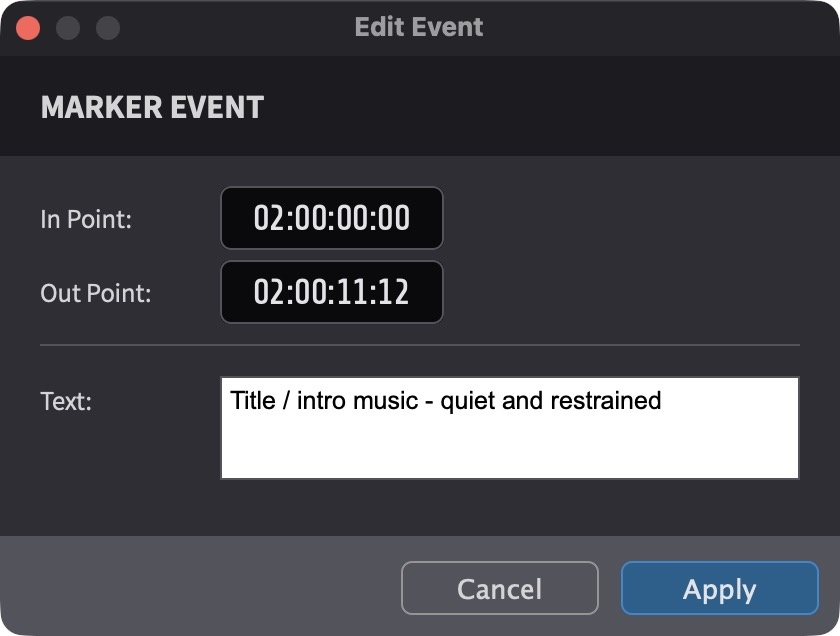
Pro Tools Integrated Mode - Edit Event Window
In Pro Tools Integrated Mode, double-clicking a Marker in the Event List opens the Edit Event window, where the Marker's timecode position can be fine-tuned numerically and text can be added or edited.
Media Mode - Properties Tab
In Media Mode, double-clicking a Marker in the MARKERS track or the Event List brings the Properties tab to the forefront, where the Marker's timecode position can be fine-tuned numerically and text can be added or edited.
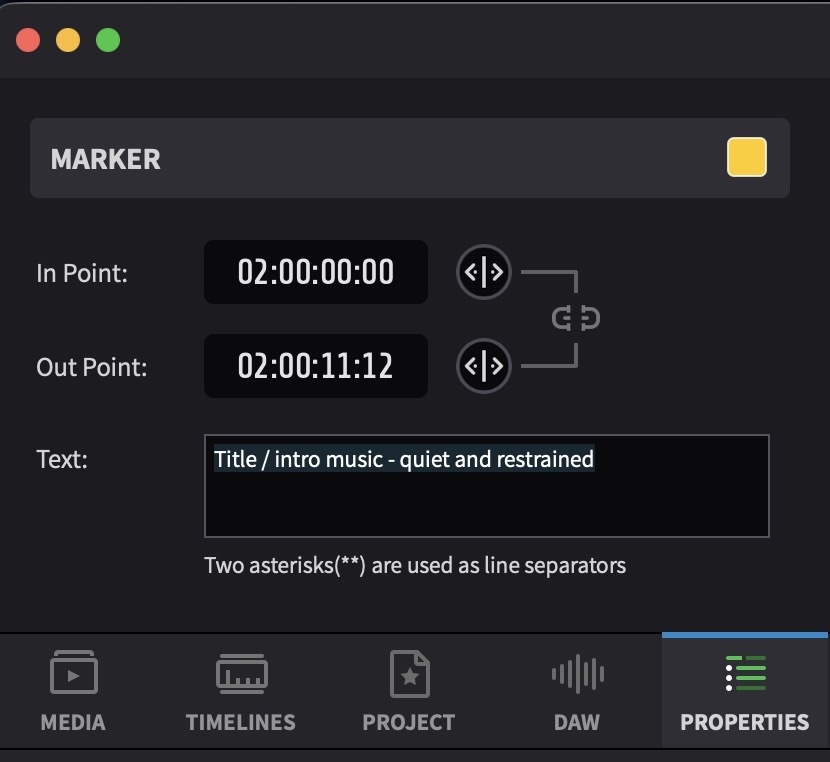
Timecode fields can be edited in multiple ways. To scrub-adjust a timecode, click and hold the arrow button to the right of the timecode field and drag left or right. Dragging slowly produces finer changes, while dragging further produces larger changes.
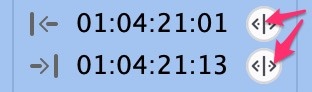
To retype a timecode, click the field once so the entire timecode is selected, then type the full hours, minutes, seconds, and frames (excluding colons). The period and comma keys can be used as shortcuts to enter double zeroes into timecode fields, speeding up entry.
Press Enter or click elsewhere to confirm the new value.
To adjust only one specific timecode field (such as frames), double-click just that field so only it is selected, then retype the value. Subsequent fields will not change or will default to zero.
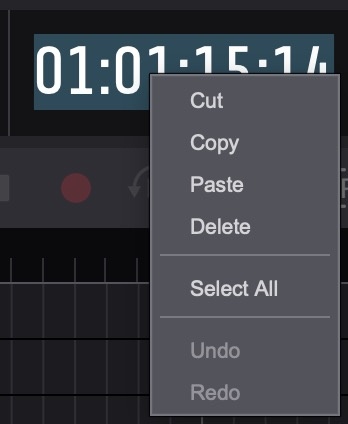
To copy and paste timecode values, double-click the timecode field to highlight it, then right-click to access a context menu with Cut, Copy, Paste, Delete, Select All, Undo, and Redo. This context menu is available on all timecode fields throughout the application - including the main counter, selection in/out counters, and timecode fields in the Properties tab, Edit Event window, and Event List. It allows timecodes to be copied from external sources - such as a DAW, spreadsheet, or email - and pasted directly into the field, or copied from Cue Pro and pasted elsewhere.
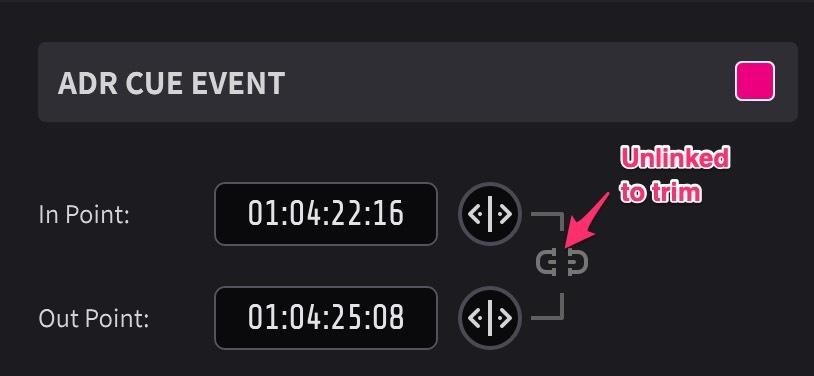
To trim a Marker's start or end timecode independently, ensure the link button between the In Point and Out Point is not enabled (un-linked). Editing one timecode field will then adjust only that boundary, keeping the other in place.
Marker boundaries can be modified directly in the Event List by dragging the timecode adjustment controls (small up/down indicators) located next to the In Point and Out Point fields.
Moving Markers
One or more Markers can be moved on the timeline by first selecting them, then positioning the pointer in the lower half of the Marker so the hand symbol displays, and clicking and dragging to the new position.
Note: In Timeline Range Mode, only Markers that are wholly within the selection range will be moved - partially selected Markers are ignored. In Target Event Mode, all highlighted Markers (even those partially selected) are selected in their entirety and will be moved.
Selected Markers can be nudged frame-by-frame using the , (comma) key to move 1 frame earlier, or the . (period) key to move 1 frame later.
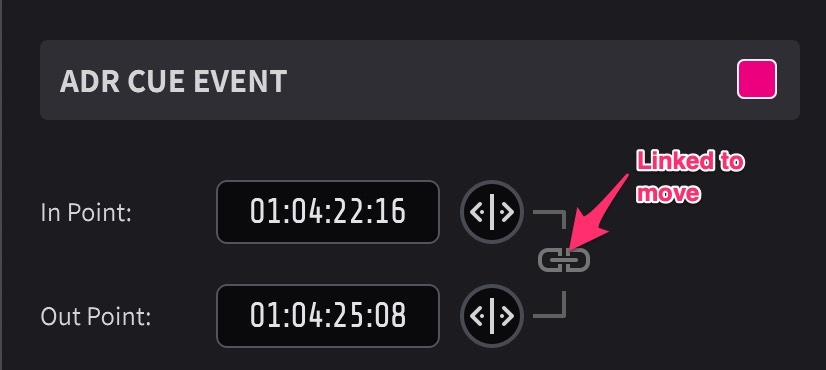
To move a Marker while preserving its duration using timecodes, ensure the link button between the In Point and Out Point is enabled (linked). Editing one timecode field will then relatively adjust the other to maintain the Marker length.
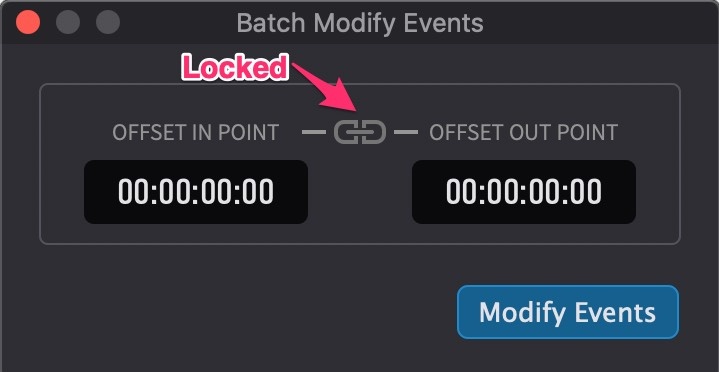
To move multiple selected Markers simultaneously by an exact numeric amount, select the Markers and choose Modify Selected Events from the Event menu. In the Batch Modify Events window, click the lock icon to maintain the duration of the Markers, then enter an offset amount in the In Point or Out Point fields.
Duplicating Markers
To duplicate one or more highlighted Markers while moving them to a new position, hold Option while dragging the Markers on the timeline.
Alternatively, with Markers highlighted, press Command & D to duplicate them in place - the new Markers are created at the exact same position as the originals, stacked on top. This command is also available from the Event menu as Duplicate Current Events.
Merging Markers
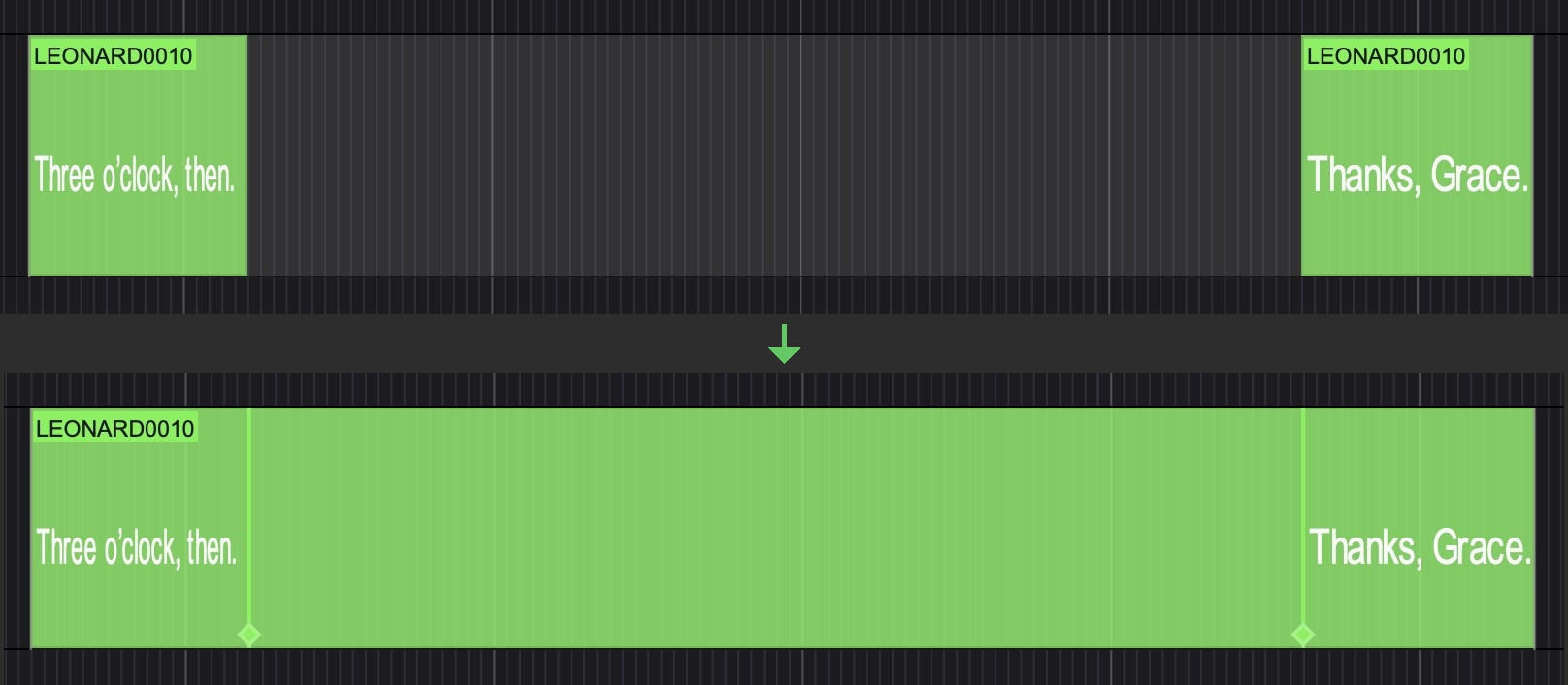
Two or more Markers can be selected and merged by pressing Option & Command & M. This command is also available from the Event menu as Merge Selected Events.
The text fields from all selected Markers are automatically joined together in the order they appear, resulting in a single Marker with combined text content.
Editing Marker Text
To edit a Marker's text, double-click the Marker to open the Properties tab (Media Mode) or Edit Event window (Pro Tools Integrated Mode). The Text field is automatically selected and ready for input.
Splitting a Marker
A selected Marker can be split by scrubbing to the desired split point within the MARKERS track and pressing B. This command is also available from the Event menu as Split Selected Event At Playhead.
If the Marker contains text, the Split Text window appears, allowing the text to be divided between the two resulting events. Click at the desired split point in the text, or use the nudge hotkeys:
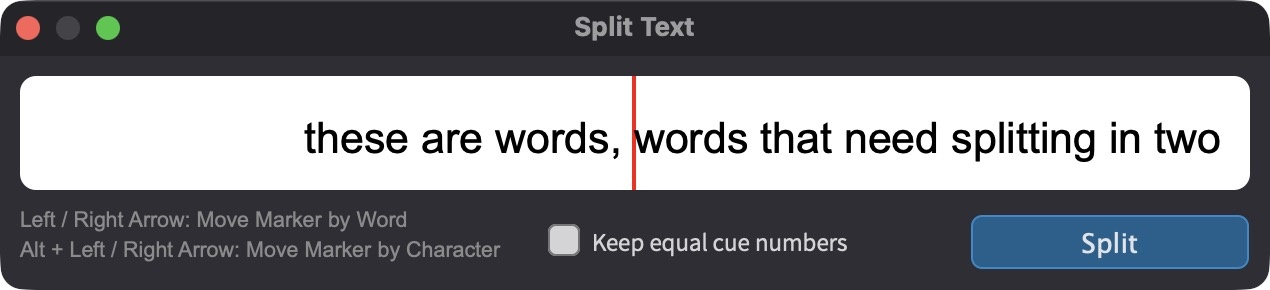
- ← / →: Move insertion point by word
- Option & ← / →: Move insertion point by one letter, number, or symbol
Once the correct position is selected, click Split or press Return.
Note: If the Marker contains no text, the Split Text window is not displayed - the split occurs immediately at the playhead position.
The Split Text window includes a Keep equal cue numbers toggle. When enabled, both resulting Markers retain the same cue number. When disabled, the split produces two Markers with the original cue number suffixed a and b.
Deleting Markers
One or more selected Markers can be deleted by pressing the Delete key. This command is also available from the Event menu as Remove Selected Events.
Note: In Timeline Range Mode, a partial selection over a Marker will trim it to the selection boundary rather than deleting it entirely. Only Markers fully within the selection range are deleted. In Target Event Mode, all highlighted Markers (even those partially selected) are selected in their entirety and will be fully deleted.
Muting Markers
One or more selected Markers can be muted by pressing Command & M. Pressing the same shortcut again unmutes them. Muting a Marker hides it from the overlay output without deleting it from the project. Muted Markers appear greyed out on the timeline and in the Event List, and are skipped during prev/next event navigation. The mute state can also be toggled directly via the On column in the Event List.
Note: The same edit mode behaviour applies to muting - in Timeline Range Mode, partial selections will only affect Markers fully within the range, while Target Event Mode affects all highlighted Markers in their entirety.
Sorting Events
The Event List can be sorted by clicking a field heading to sort by that column. Clicking again switches between ascending and descending order. Markers with identical timecodes retain their initial sort order when the list is sorted by timecode.
Sorting is useful for organising events in different ways - for example, sorting by text to group similarly named Markers together, or sorting by Out Point to find the last event in the timeline.
Customising the Event List
Column order can be rearranged by clicking a column header and dragging it to a new position.
Column width can be adjusted by clicking the right edge of a column header and dragging.
Columns can be shown or hidden by right-clicking (or Control-clicking) any column header.
Navigating Events
The Event List provides several methods for navigating between events:
- ↑ or Command & ← to select the previous event
- ↓ or Command & → to select the next event
These commands navigate through all visual events in the Event List, not just Markers. Navigation follows the current sort order. If navigation behaves unexpectedly, check which column the list is sorted by and whether it is set to ascending or descending order.
When Cue Pro is not in focus, system-wide hotkeys can be used to navigate between events where they have been configured in Preferences / Settings. Command & F5 selects the previous event and Command & F6 selects the next event.
On Macs where F keys are not configured to act as standard function keys, Fn must also be held - for example, Command & Fn & F5. This setting can be found in System Settings → Keyboard → Function Keys.
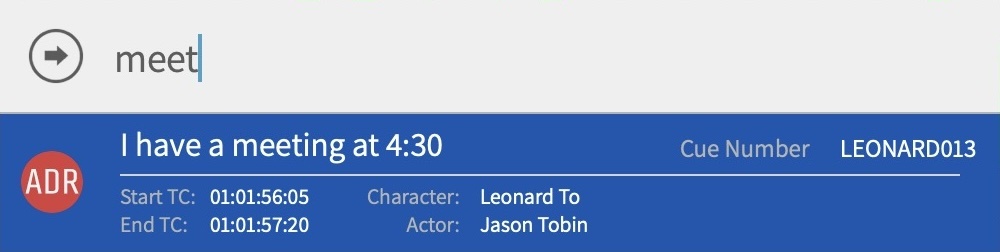
The Go To command (Command & G) allows quick navigation directly to a specific event. Pressing the shortcut opens a text input box. Begin typing and a list of matching candidates from all event types appears immediately below. Clicking an event from the list selects it and moves the playhead to its position.
Typing # followed by a cue number searches specifically by cue number — for example, entering #12 will find all cues containing 12 in their cue number.
Selection expansion commands allow multiple events to be selected quickly. These commands apply to all visual event types, not just Markers:
- Command & Option & A includes all events before the current selection
- Command & Shift & A includes all events after the current selection
- Command & A selects all events in the list
Navigating Markers on the Timeline
In Timeline Range Mode, Markers can be navigated directly on the timeline using the Tab key. Press Tab to move the playhead forward to the next event boundary, and Option & Tab to move backward. The playhead stops at the start and end of each Marker, making it straightforward to navigate through Markers on the timeline.
Hold Shift while pressing Tab to make a timeline selection as the playhead advances, extending the selection from the current position to the next event boundary. Shift & Option & Tab extends the selection in the opposite direction.
Event Selection Playhead Behaviour
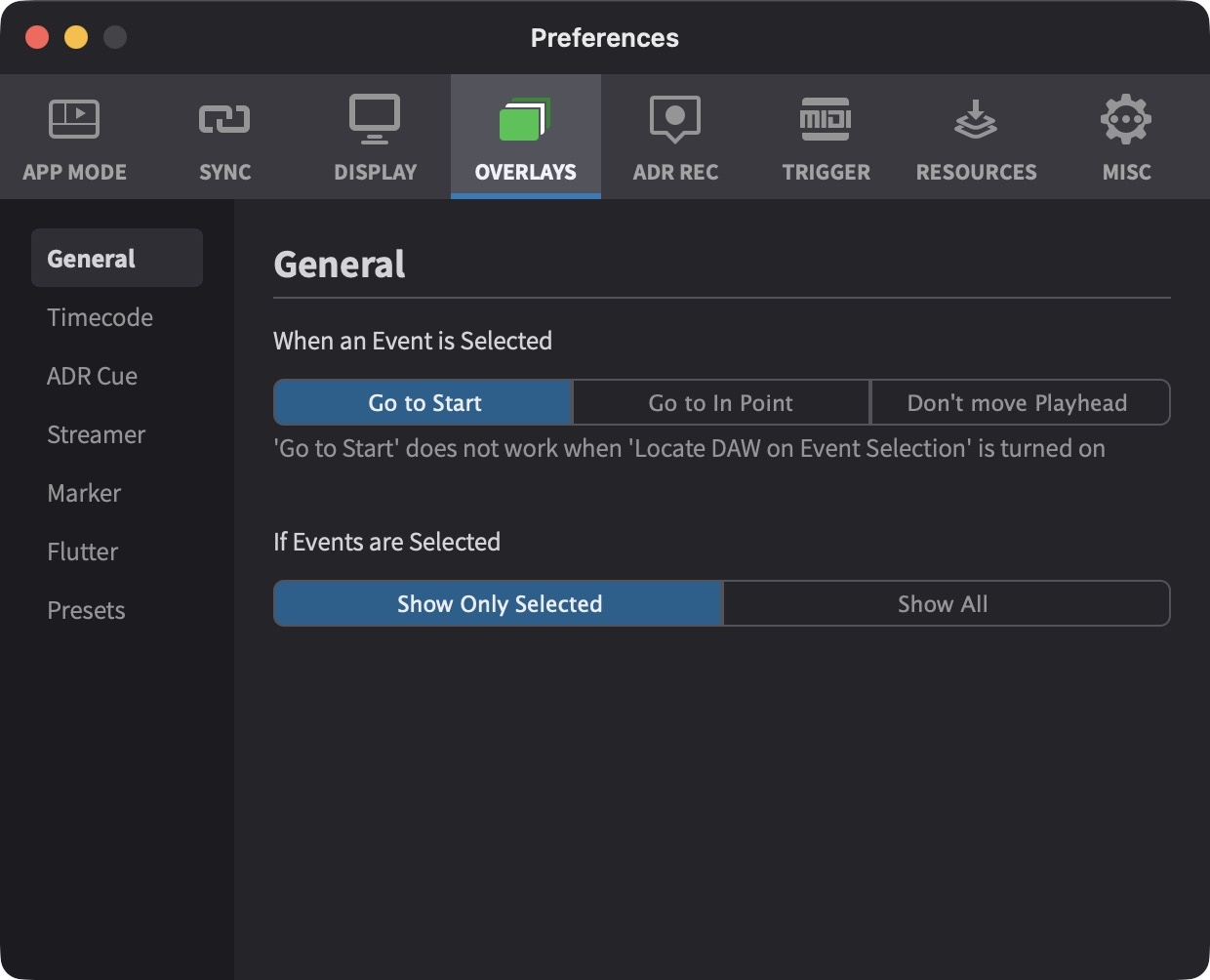
Settings under Preferences / Settings → OVERLAYS → General tab control what happens when an event is selected:
When an event is selected - choose between Go to Start, Go to In Point, or Don't move Playhead. This setting controls playhead positioning when an event is selected. The distinction between Go to Start and Go to In Point primarily affects overlay types with Streamer countdowns - ADR Cues and Streamers - where the start of the pre-roll differs from the In Point.
If Events are Selected - choose between Show Only Selected (only the selected event's overlays are rendered) or Show All (all events' overlays are rendered during playback).
Playback Modes
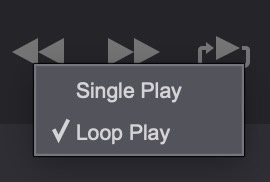
Hold down the Control key while clicking the play button to choose between Single Play and Loop Play modes.
MIDI Triggers
Unlike Streamers, Flutters, and ADR Cue pre-rolls, Markers cannot be triggered via MIDI input and must be created manually using the methods described in this chapter.
Enabling Marker Overlays
Cue Pro operates in one of two modes - Pro Tools Integrated Mode and Media Mode - which determines how video devices and their overlay controls are presented in the Device List. The current mode affects how overlays are enabled and which devices are available.
Pro Tools Integrated Mode
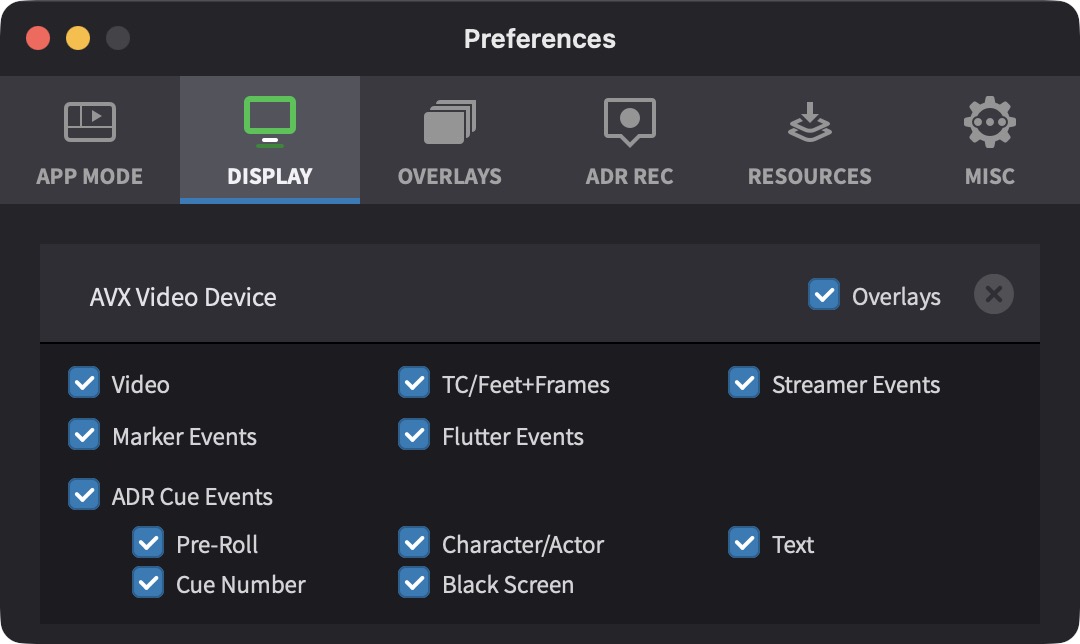
In Pro Tools Integrated Mode, a single Pro Tools AVX Video Device is shown in the Device List in Preferences / Settings → DISPLAY tab. The Overlays checkbox toggles all overlays on or off for this device. When Overlays is enabled, the Marker Events checkbox controls whether Markers are visible.
Media Mode
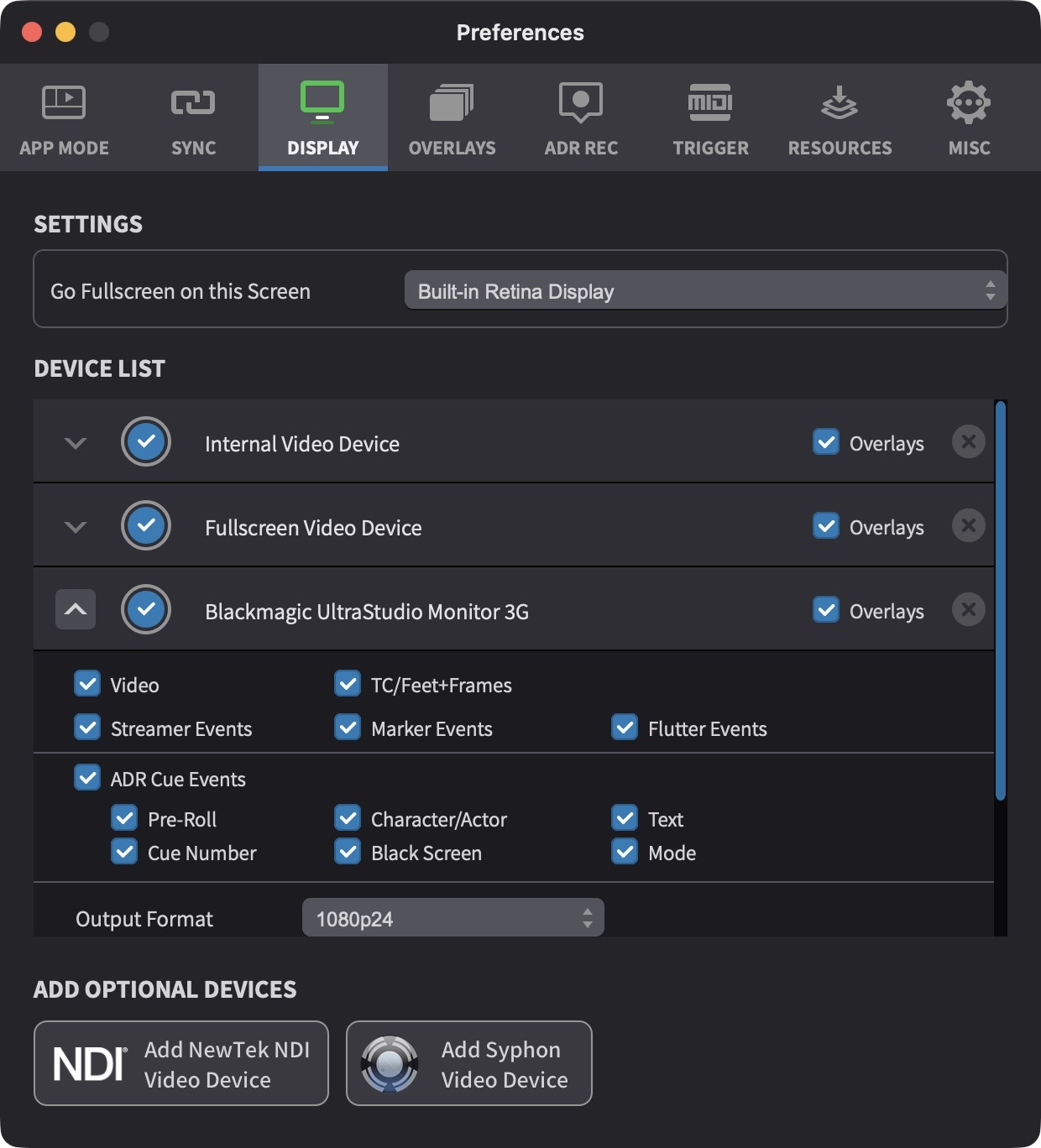
In Media Mode, the Device List shows all available video output devices - including video hardware, the Fullscreen Video Device, and the Internal Video Device - each with independent overlay controls. Click on the left-most grey arrow of the relevant video device to show the expanded settings, so that the arrow is pointing up.
Each device can independently show or hide Marker overlays using the Marker Events checkbox. The Overlays checkbox on each device toggles all overlay types on or off for that device. This allows flexibility when setting up multiple outputs - for example, a composer can have Markers visible on their main display while a director's monitor remains clean.
Global Toggle Shortcuts
To toggle all overlays across all devices globally, press Shift & Command & B, or select Toggle Overlays Globally from the View menu.
Marker Settings
All Marker overlay settings are configured in Preferences / Settings → OVERLAYS → Markers tab. The available options provide complete control over how Markers appear on screen.
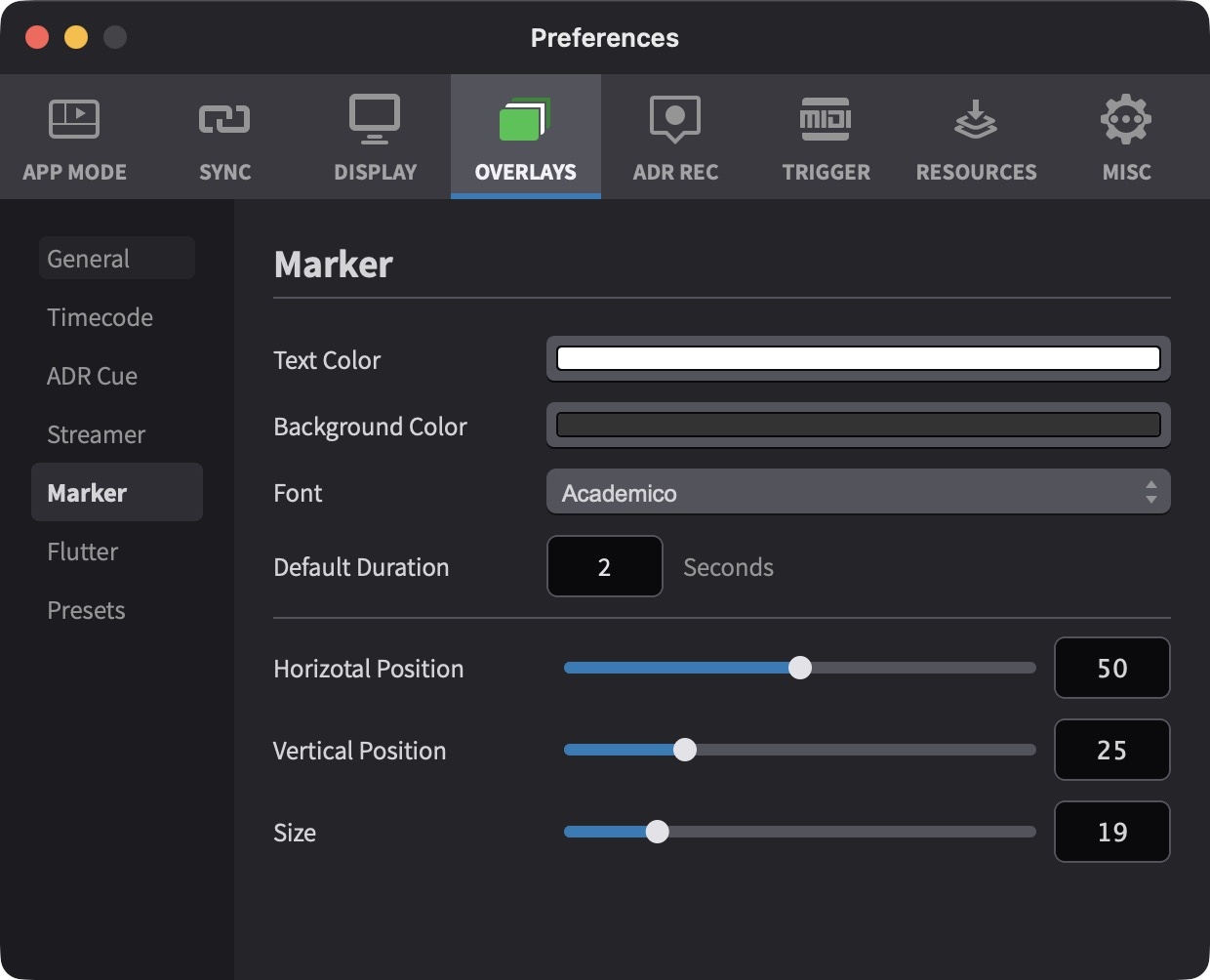
When a setting is adjusted, a temporary preview of the overlay is automatically displayed on all available video devices for a few seconds, allowing settings to be fine-tuned visually. Overlays do not need to be enabled in the Device List, and events do not need to be added to the timeline, in order to preview settings changes.
If overlays are visible when adjusting settings but not during playback, ensure that the overlay type is enabled for the relevant device in the Device List (Preferences / Settings → DISPLAY tab), and that overlays have not been disabled globally via Toggle Overlays Globally in the View menu.
Overlay appearance settings apply globally - they are shared across all video devices, projects, and timelines.
The font, text colour, and background colour of the Marker overlay can be configured here.
A colour is chosen from the Base Colors palette and adjusted using the Lightness slider. To remove the background completely, drag the Opacity slider to 0%.
The Default Duration setting determines how long a newly created Marker will be, based on the project's current reference unit (timecode, feet and frames, etc.). This default duration applies whenever a new Marker is created without a timeline selection prior to creation, or during a bulk text import where no end timecode column is present.
Position adjustments allow precise placement of Markers on screen. The Position: Horizontal slider moves the Marker left or right across the display. The Position: Vertical slider adjusts the vertical placement - moving left positions the Marker lower on screen, while moving right positions it higher.
The Size slider controls how big or small the Marker overlay appears on screen.
Overlay Presets
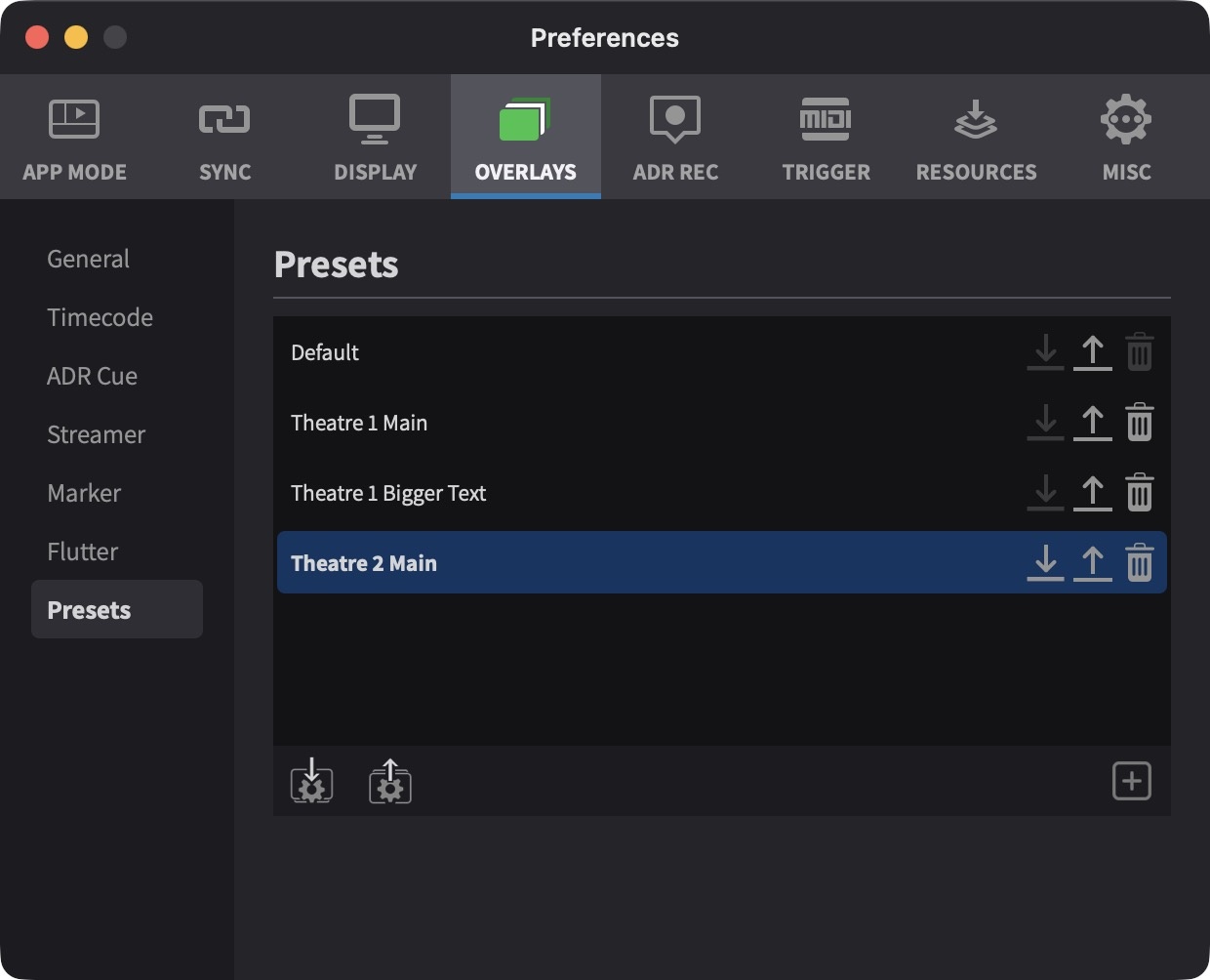
Overlay settings can be saved and managed through the Presets item in the OVERLAYS sidebar in Preferences / Settings. A Default preset is always present and cannot be deleted or renamed. The currently active preset is highlighted, and a modified indicator shows when unsaved changes exist.
Loading a preset: Double-click the preset name to load it.
Saving changes to a preset: Click the Save button (↓) on the preset row. The Default preset cannot be overwritten. When the current settings have been modified since the preset was last loaded or saved, an asterisk (*) appears after the preset name to indicate unsaved changes.
Reverting a preset: Click the Revert button (↑) on the preset row to discard unsaved changes and restore the preset's last saved state.
Creating a new preset: Click the + button below the preset list.
Renaming a preset: Click the preset name in the list. The Default preset cannot be renamed.
Deleting a preset: Click the Delete button on the preset row. The Default preset cannot be deleted.
Importing and exporting presets: Use the
Import (↓) and Export (↑)
buttons at the bottom left of the Presets page to share
.dispPref preset files between studios, editors, or
machines.